
Reviewed · ZURICH TOURS
Self-Guided Audio City Tour in Zurich
Zurich’s past is packed into a walkable route that runs from the main station through the Old Town, across church squares, beside the Limmat River, and toward the Opera House. This self-guided audio tour gives you the stories behind places you might otherwise treat as pretty buildings: Lenin’s former apartment, the birthplace of Dada, ancient Roman baths, and the monuments of Zwingli and Hans Waldmann.
I like the freedom to pause, skip, or stop for coffee without holding up a group. I also like the useful mix of written captions, photos, and directions, which can help when city streets become confusing. The main caution is time: the advertised two to three hours can become three and a half or even four and a half hours if you stop often, read everything, and visit interiors.
Key points to know before you go
- A history-heavy route through central Zurich: You’ll connect Roman remains, medieval churches, Reformation sites, banking squares, modern art, and political history in one walk.
- Your phone is your guide: Bring your own internet-enabled mobile phone and headphones. There is no live guide.
- The route starts at Zurich’s main station: Meet by the Alfred Escher Statue at Bahnhofplatz and finish near Max Bill’s Pavilion Sculpture on Bahnhofstrasse.
- Fraumünster costs extra inside: The exterior is part of the route, but entering the church requires an additional CHF 5 admission fee.
- Allow more than the stated minimum time: The route can take about two hours if you move briskly, but leisurely walkers may need three and a half to four and a half hours.
- The price is low for a first look: At $13.29 per person, it works best as an affordable introduction, not as a substitute for a full live guide.
From Alfred Escher to Zurich’s civic story
The route begins beside Zurich’s main station at the Alfred Escher Statue. Escher was a major Swiss politician linked to the country’s economy and railway system, so this opening stop gives you an immediate lesson in how transport and industry helped shape modern Switzerland.
You spend only about five minutes here, but the location is practical. Bahnhofplatz is easy to reach by public transport, and the station gives you a clear starting point in a city where the Old Town’s lanes can quickly twist into one another.
Next comes Pestalozzianlage and the monument to Johann Heinrich Pestalozzi. Pestalozzi’s work in education makes this more than a quick statue stop. The audio places his ideas in a wider story about social change, learning, and the effort to improve ordinary lives.
You’ll also pass the Urania Observatory. The supplied route gives it its own point of interest, even though the stop numbering is not perfectly consistent. Treat the observatory as a short look at Zurich’s interest in science and the night sky rather than a full observatory visit.
More Self-Guided Trails in Zurich
- Zurich: City Bus Tour with Audio Guide and Lake Cruise
★ 4.3 · 1,195 reviews - Zurich City Tour with Audio Commentary
★ 4.0 · 372 reviews - Zurich: City Top Attractions Tour by Bus with Audio Guide
★ 4.3 · 282 reviews
Lindenhof gives you the first grand view

Lindenhof Hill is one of the route’s best pauses. From this elevated terrace, you can look across the Old Town and toward the Limmat River. After several small monuments and dense streets, the open view gives you a welcome sense of how Zurich fits together.
The audio also points out the Hedwig Fountain, the Masonic Lodge, and the Tombstone of Lucius Aelius. These details reward you if you enjoy clues tucked into the city rather than only famous sights. I would give Lindenhof more than the listed ten minutes if the weather is good.
There is a practical tradeoff. The route uses many short stops, but you should not feel obliged to leave when the suggested time expires. Self-guided touring works best when you take the schedule as a loose guide. Lindenhof is exactly the kind of place where an extra ten minutes can improve the day.
Zurich’s churches tell several different stories
St. Peter’s Church is next, with about ten minutes suggested. Its huge clock face is the obvious visual draw, but the audio also helps explain why this old parish church matters to Zurich’s identity.
The church visit is useful for travelers who want more than a quick photograph. You can pause inside and notice the quieter mood after the traffic and movement of the city center. Still, the audio gives considerable attention to churches throughout the route, so listeners who prefer modern culture or political history may find this section a little long.
At Thermengasse, the focus shifts much further back. The remains of Zurich’s Roman baths offer a small but important link to the city’s ancient past. You should not expect a large archaeological complex. Instead, you get traces in the middle of the present-day city, a reminder that Zurich was already a settled place long before its banks, trams, and shopping streets.
The Town Hall, or Rathaus, brings the route back to civic life. This stop is brief, about five minutes, but it adds political context to the religious and archaeological sights. The building helps show how Zurich’s public institutions developed alongside its churches, guilds, and commercial center.
Dada, Lenin, and the city’s more surprising side
Cabaret Voltaire is one of the most memorable stops because it breaks up the old churches and civic monuments. This was the birthplace of the Dada movement, where artists, writers, and intellectuals challenged accepted ideas through strange, playful, and provocative work.
You only get about five minutes at the site, so the audio matters. Without context, Cabaret Voltaire can seem like just another Old Town building. With the story, it becomes a place where Zurich’s artistic character looks less orderly and much more rebellious.
The Lenin Apartment adds another unexpected chapter. Vladimir Lenin lived in Zurich during political exile, and the stop considers the period when he was developing ideas that later changed world politics.
This is a good example of the route’s value. It does not limit Zurich to grand churches and beautiful river views. It shows how the city also offered shelter, meeting places, and intellectual space for people far outside Swiss public life.
A few more Zurich day trips to weigh up
- The Dark Side of Zurich: Self-Guided Audio City Tour
★ 4.4 · 52 reviews - Zurich: Audio Guided City Tour and Train to “Top of Zurich”
★ 4.2 · 41 reviews - Einstein in Zurich: Walk in Time Exploration Game and Tour
★ 4.0 · 25 reviews - Zurich in the Mirror of the Past: Self-Guided Audio Tour
★ 3.8 · 15 reviews
Grossmünster and the Reformation
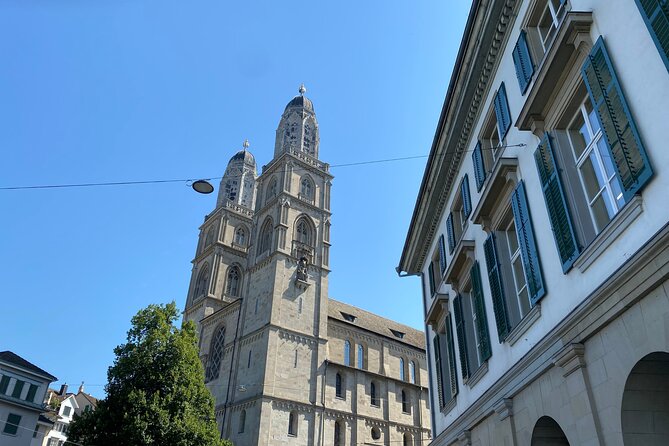
Grossmünster receives the longest suggested visit, about 15 minutes, and deserves the extra time. Its twin towers are among Zurich’s most familiar sights, but the church’s real importance comes from its role in the Swiss Reformation.
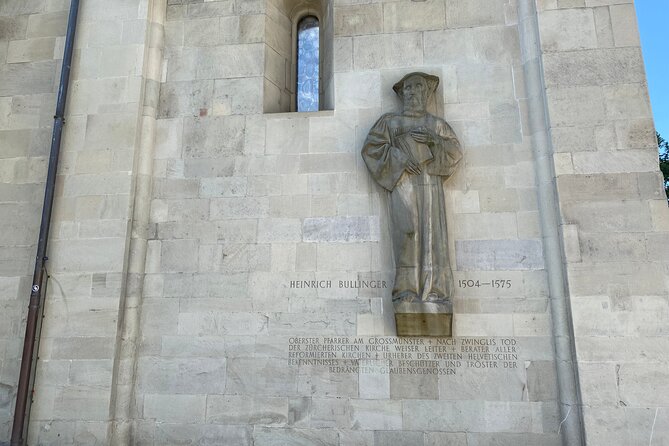
The audio introduces Ulrich Zwingli and the religious changes that reshaped Zurich. That story gives the city’s churches a stronger connection to one another. St. Peter’s, Grossmünster, Wasserkirche, and Fraumünster are not isolated stops. Together, they show how religion influenced public life, art, architecture, and politics.
Inside Grossmünster, look for the stained glass windows by Augusto Giacometti. Their color and light offer a striking change from the church’s older stone architecture. The experience is especially valuable for you if you enjoy seeing how newer art can alter the feeling of an old building.
Across the river, Wasserkirche offers another short stop and more stained glass. Its position beside the Limmat makes it easy to combine with river views and nearby bridges. The audio explains the windows and the church’s place in Zurich’s story without requiring a long visit.
The Ulrich Zwingli Monument follows naturally. It gives a physical focus to the Reformation story you have just heard. The statue is not only a portrait of a religious leader. It also points to the intellectual and political force of his ideas in sixteenth-century Zurich.
Opera, sculpture, and a walk toward the lake
The route then moves toward the Opera House. Its facade carries busts of composers and writers, making the building a useful stop even if you are not attending a performance.
This section changes the mood. You move from religious reform and medieval power toward Zurich’s cultural life. The Opera House helps round out the city as more than an old center with churches and guild halls.
Nearby, the Ganymed sculpture adds a mythological and artistic note. It is a short stop, but it shows the tour’s interest in public art as well as major landmarks. You may appreciate these smaller points if you like finding unusual works along a walking route.
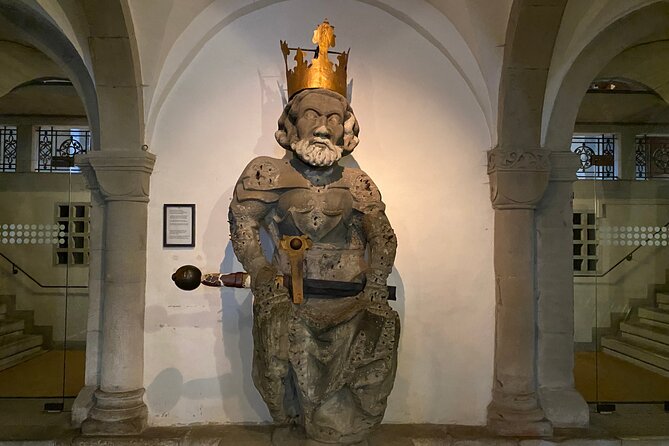
The Hans Waldmann Statue offers a darker piece of civic history. Waldmann rose from modest beginnings to become burgomaster and one of Zurich’s leading figures, but his life ended with a death sentence. The statue becomes more interesting once you know that rise and fall.
These brief stops can feel fragmented if you rush. I would use the audio as a framework, then give yourself permission to linger at the places that catch your attention. You can also skip sections easily, which is one of the strongest reasons to choose this format.
Fraumünster requires a small budget decision
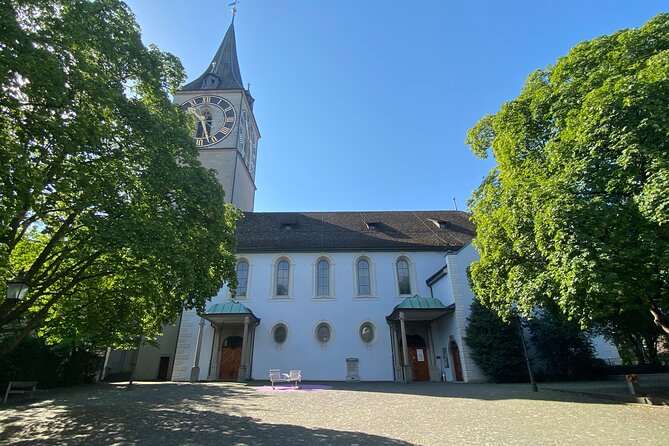
Fraumünster is one of Zurich’s essential church visits, especially for its stained glass windows by Marc Chagall. The color and design make the interior very different from Grossmünster and St. Peter’s.
The exterior is part of the walking route, but entering costs CHF 5 per person. That is a small extra charge, yet you should know about it before you arrive. If you want only the church’s setting and outside architecture, you can continue without paying. If Chagall’s work interests you, the admission is likely worthwhile.
The route also passes Paradeplatz, Zurich’s financial center. This is where the city’s modern banking identity comes into view. It can feel like a sharp change from Roman ruins and medieval churches, but that contrast is useful. You see how a compact historic center now operates as a major business district.
Augustine Church provides another quiet historical pause. Its simple appearance may appeal more to you than the grander churches if you prefer a less decorated interior. The stop is short and works well as a moment to slow down before the final section.
Guilds, workers, and the Max Bill ending
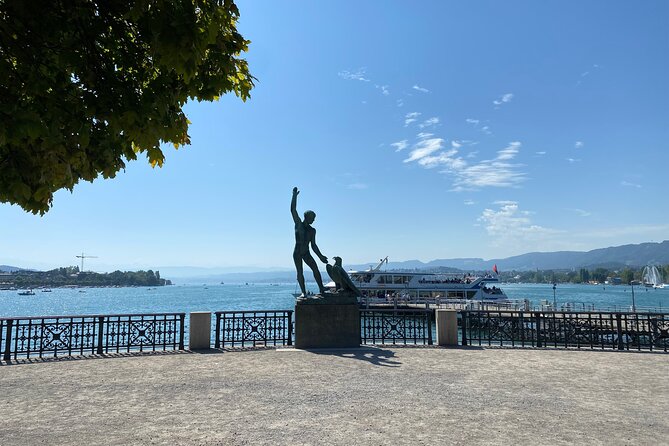
At Weinplatz, the audio turns to Zurich’s working life through the Millers’ and Bakers’ Guild Building. This is a valuable stop because it shifts attention away from rulers, reformers, artists, and wealthy institutions.
Guilds helped organize trades and shaped urban life, so the building gives you a glimpse of how workers and merchants fit into old Zurich. The route does not only show polished facades. It also asks you to notice the systems behind the city’s daily life.
The formal end comes at Max Bill’s Pavilion Sculpture on Bahnhofstrasse 47. Max Bill’s work is described through ideas of transparency, equality, and freedom. After the dense detail of the Old Town, the modern sculpture offers a clean, open final note.
The end point is next to the Pavilion Sculpture, not back at the train station. That matters if you are planning a train departure or have a timed reservation. You finish in a central area, but you should still allow time to orient yourself before moving on.
How long should you set aside?
The official estimate is two to three hours, but you should plan with flexibility. One person completed the route in about three and a half hours, even while reading captions instead of listening to every audio segment. Another took roughly four and a half hours at a relaxed pace and reached about 65 of the 111 landmarks available through the audio experience.
That difference tells you what this tour really is. It is not a tightly timed march from one attraction to the next. It is a large collection of points that you can use selectively.
Plan on at least three hours if you want to listen carefully. Add time for church interiors, photos, views from Lindenhof, food, shopping, and any stops you make along the way. Good walking shoes are important because the route covers a lot of ground.
Phone, audio, and navigation tips
You receive access through a link and use your own phone, internet connection, and headset. There is no live guide, so you need to manage playback and navigation yourself.
The audio includes photos, clear directions, and written captions. Those tools are helpful, especially when street signs are hard to see. Still, navigation is not foolproof for everyone. Keep the route open, check the photos carefully, and do not assume every turn will be obvious in the Old Town.
Phone battery deserves real attention. Audio playback, mobile data, photographs, and navigation can drain a phone during a long walk. Start with a full charge and carry a power bank if you have one.
There have also been occasional problems with the audio link or playback restarting. If the audio begins again from the start, captions can keep you moving while you sort it out. Downloading or saving any available written material before setting off may also help, although the supplied information does not promise offline access.
The access remains valid for a year from purchase, which gives you unusual flexibility. You can complete part of the route, stop for the day, and return later rather than forcing every landmark into one exhausting walk.
Is $13.29 a fair price?
At $13.29 per person, this is a strong low-cost way to get an introduction to central Zurich. The price covers an English audio guide, directions, photos, and access to a broad set of sights. Since nearly every stop is free from the outside, you are mainly paying for the explanations and route design.
That value depends on how you like to tour. If you want a personal guide who can answer questions, adjust the pace, and explain what you are seeing in real time, this will feel limited. A more expensive live tour may give you more connection and a clearer sense of priority.
If you want privacy and control, the price is easier to justify. You can skip church details, linger at a view, stop at a shop, or add your own destinations without asking a group to wait. The written transcript is another useful feature, particularly if you process information better by reading.
The tour is best for a first visit, independent walkers, history fans, and couples or friends who do not want to follow a fixed group schedule. It may be less suitable if you have only a short window, dislike phone-based navigation, or want a narrow focus on modern Zurich, food, or World War II sites. The route gives little attention to bomb shelters and twentieth-century wartime subjects, so do not choose it for that purpose.
Should you book it?
Book this tour if you want an affordable, flexible walk that explains why Zurich’s Old Town looks the way it does. The strongest parts are the route’s range, the views from Lindenhof, the Reformation story around Grossmünster, and the unexpected stops at Cabaret Voltaire and Lenin’s former apartment.
Skip it if you need a live guide, firm two-hour timing, or guaranteed trouble-free audio. For most independent visitors, the best plan is to treat it as a self-guided framework, not a race. Bring headphones, internet access, a full battery, and comfortable shoes, then use the year-long access to finish at your own pace.
FAQ
Where does the Zurich audio tour start?
It starts at the Alfred Escher Statue in Bahnhofplatz, near Zurich’s main train station.
Where does the tour end?
It ends next to Max Bill’s Pavilion Sculpture at Bahnhofstrasse 47 in central Zurich.
How long does the tour take?
The stated duration is approximately two to three hours. Depending on your pace and how many sights you visit, it can take about three and a half to four and a half hours.
Is there a live guide?
No. You explore independently using the audio link provided after booking.
What do I need to bring?
You need your own mobile phone with internet access and a headset. A well-charged phone is especially important because audio, directions, and navigation use battery power.
Does the tour include admission to Fraumünster?
The walking route includes Fraumünster, but entering the church requires an additional CHF 5 per person.
More Audio Tours in Zurich
- Self-Guided Audio Tour to the Dark Side of Zurich
★ 4.5 · 14 reviews - Historical Zürich: A Self-Guided Audio Tour Through the city of 1,000 Fountains
★ 5.0 · 11 reviews - Basel: Sightseeing Bus Tour with Audio Guide
★ 4.2 · 205 reviews - The Many Faces of Geneva: Self-Guided Audio City Tour
★ 3.9 · 44 reviews
Just added around Zurich
- 2 Hour Floating Harmony Couples Course★ 5.0 · 3 reviews
- Lake Zurich boat tour for an afternoon !★ 5.0 · 3 reviews
- From Zurich: 7-Day Tour to Geneva with Tickets and Lodging★ 5.0 · 3 reviews
- Lake Zurich mini boat tour / by night!★ 5.0 · 3 reviews
- Zurich: Private tour to Interlaken, Grindelwald & Jungfrau★ 5.0 · 3 reviews
- Zurich Premium Fitness Pass★ 3.0 · 3 reviews
- Central Switzerland (Private Tour)★ 5.0 · 3 reviews
- Wakeboarding Lake Zurich – afternoon !★ 5.0 · 3 reviews
Zurich Tours, compared.
Zurich: Day Trip to Grindelwald, Interlaken & Lauterbrunnen
Read our review →
Zurich: City Tour, Cruise, and Lindt Home of Chocolate Visit
Read our review →
From Zurich: Bus Day Trip to Heidiland and Liechtenstein
Read our review →
Zurich: City Highlights Tour by Bus, Cable Car, and Ferry
Read our review →
Mount Titlis and Lucerne Day Trip from Zurich
Read our review →
Heidiland and Liechtenstein Tour from Zurich
Read our review →Browse the lists this tour appears in