
Reviewed · LUCERNE TOURS
1.5-Hour Small-Group Nightwatchman Walk in Medieval Lucerne
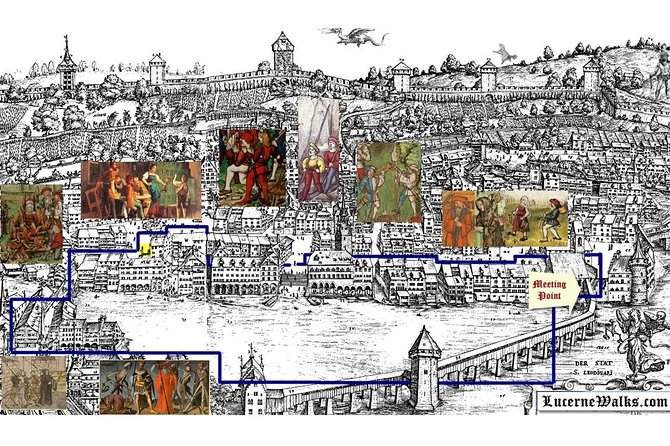
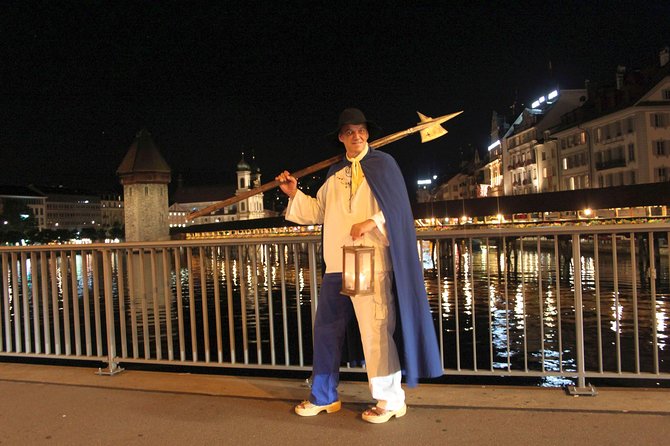
Lucerne becomes a different city after dark. On this 90-minute Nightwatchman walk, you follow the route of the old town through lanes, squares, bridges, and riverside corners while a costumed guide explains how medieval Lucerne worked, feared, prayed, and punished. The 1597 Martiniplan, projected images, and stories of ghosts and executions give the walk more life than a standard sightseeing stroll.
I like two things in particular: the tour uses visual aids, including the first map of Lucerne and projected artwork, and it keeps you moving through real medieval streets rather than parking you in one lecture spot. I also like the small touches, such as tasting fountain water and receiving postcards featuring old Lucerne art.
The main drawback is that the stories can turn grim, with torture, corporal punishment, and executions entering the picture. One person also found the guide’s pace a little quick, so wear sensible shoes and speak up if you need a slower walk.
Key points to know before you book
- See Lucerne through the 1597 Martiniplan: The city’s first map helps you connect the present-day streets with the medieval town.
- Expect a theatrical guide: Your Nightwatchman wears period clothing and begins with a fire horn and invocation prayer.
- Walk through the old town’s darker side: Hear about riots, ghosts, interrogation, corporal punishment, and the pillory.
- Get more than spoken commentary: Projected paintings, historic images, and postcards make the stories easier to follow.
- Keep the group manageable: The tour accepts a maximum of 15 people, with children up to 12 free when accompanied by an adult.
- Plan for any weather: The walk goes ahead in rain or snow, so bring suitable clothing or an umbrella.
Starting at Peterskapelle with the fire horn
Meet at Rosengart Platz in central Lucerne. The walk begins at Peterskapelle, or St. Peter’s Chapel, a church dating to the 12th century and one of the oldest surviving landmarks in town.
The opening is designed to put you in the right mood. You hear a fire horn, followed by an invocation prayer, then meet the Nightwatchman in medieval dress. He explains the hard daily life of a medieval watchman, a job tied to fire, darkness, public order, and the dangers of a tightly packed wooden city.
A projector brings the past into the present. You get a close look at the Martiniplan, Lucerne’s first city map, dating from 1597. The guide traces the walking route on it and points out buildings that still exist today. This is one of the most useful parts of the experience because it gives you a simple way to understand the old town. Instead of hearing a string of dates, you can see how much of the historic street plan remains.
Beside the chapel, you also see Lucerne’s first private stone house. The guide connects it to the origin of the expression stone rich, a small detail that links architecture with social status and medieval wealth.
The stop lasts about 10 minutes. Entry to Peterskapelle is not included, so expect to view the site from the tour route rather than treat this as a separate church visit.
More Walking Tours in Lucerne
- Lucerne: Private Walking Tour with a Local Guide
★ 4.6 · 450 reviews - Lucerne Walking & Boat Tour: The Best Swiss Experience
★ 4.5 · 417 reviews - Lucerne: Guided Walking Tour with an Official Guide
★ 4.7 · 321 reviews
Chapel Bridge and the Water Tower
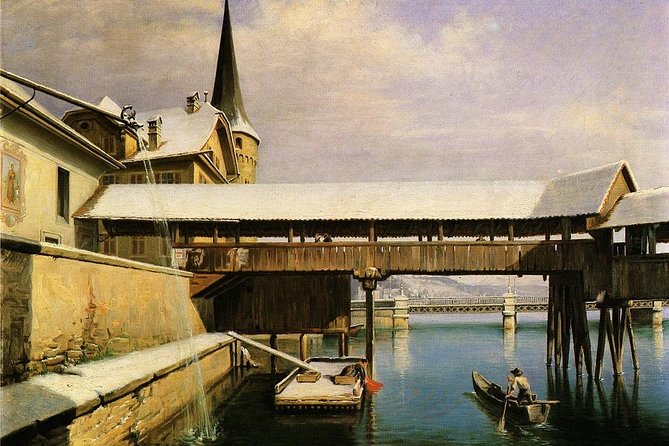
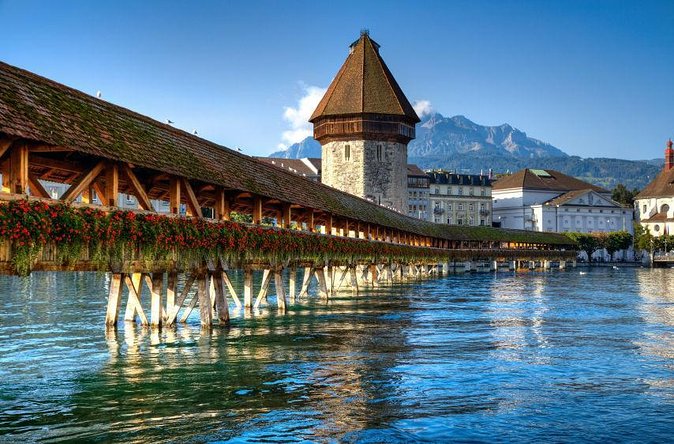
From the chapel, the group moves to Chapel Bridge, Lucerne’s famous covered wooden crossing. The guide clears up a detail many people get wrong: the Water Tower is older than the bridge. The tower dates to the late 13th century, while Chapel Bridge dates to 1365.
You see images of the Water Tower’s interior and hear about its former uses, including a torture chamber, dungeon, and secret room. This changes the way you look at the picturesque structure. It was not built simply as a pretty symbol beside the river. It formed part of the city’s defenses and carried a much more severe role.
The guide also explains where Chapel Bridge got its name. The stop is free and lasts about 10 minutes, but it gives you a helpful piece of context before you cross the bridge again near the end of the walk.
Furrengasse and medieval Lucerne after dark
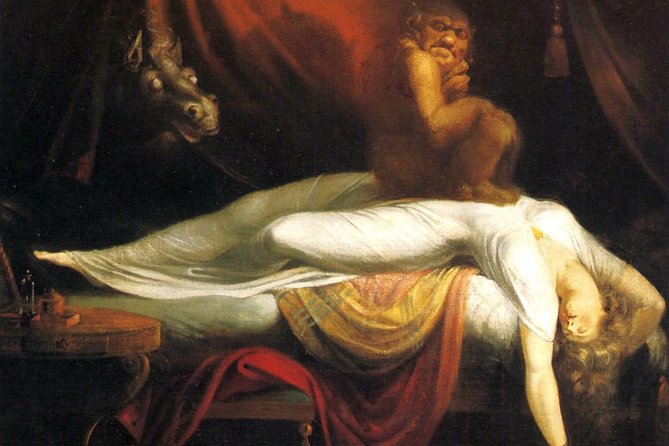
The route turns around Kapellplatz and into Furrengasse, where the tone shifts from civic history to medieval belief. You hear about life in the Republic of Lucerne during its prosperous years, then meet the ghost associated with the lane and the Toggeli, described as an incubus or love robber.
This is a good example of the walk’s style. You are not getting only official history about rulers and buildings. You also hear the fears and stories that ordinary people carried through the night. Some tales are playful, some strange, and some unsettling.
If you prefer a strictly academic tour, this blend of folklore and documented history may feel loose. If you enjoy a guide who explains how people once understood ghosts, illness, desire, and bad luck, it adds welcome color.
Kornmarkt, the town hall, and old measurements
At Kornmarkt, Lucerne’s Town Hall Square, the guide points out the Renaissance Town Hall and its tower clock. The clock has no minute hand, a small feature that says something about how time was displayed and understood in earlier centuries.
You also hear the story of the Giant of Reiden and see the Lucerne Foot and Elle, the official measures used in old Lucerne. These objects help make medieval trade more concrete. A foot or an elle was not just an abstract measurement. It shaped buying, selling, building, and the city’s rules.
The stop is free and takes about 10 minutes. I find this kind of detail especially useful if you are interested in architecture, commerce, or the practical side of city life. It moves beyond the usual list of famous buildings.
Same mountains, a completely different day out:
- From Zurich: Mount Titlis and Lucerne Day Tour
★ 4.7 · 3,381 reviews - Lucerne: Mt. Pilatus Cable Car, Cogwheel Train & Lake Cruise
★ 4.7 · 2,338 reviews - Lucerne: 1-Hour Cruise on Panoramic Yacht
★ 4.6 · 1,514 reviews - Mount Pilatus Summit from Lucerne With Lake Cruise
★ 4.5 · 1,260 reviews
Riot, fish market, and wine market stories
At Brandgässli, the Nightwatchman tells the story of the Riot of Lucerne. The narrow alley leads toward the former fish market, now known as the wine market.
The setting matters here. A small lane can feel more connected to unrest than a broad modern street, and the guide uses the space to show how public disorder unfolded within the old town. You then continue to Weinmarkt, where signs from old guest houses still hang and the buildings carry painted facades.
One of the most memorable details is the former pharmacy house of Renward Cysat. Its Latin inscription translates as There is no cure for a broken heart. It is a charming line, but it also hints at the mix of medicine, belief, humor, and symbolism found in historic town centers.
At the wine market, the guide discusses the Reformation and Counter-Reformation. You also get a glass of Lucerne fountain water, a simple refreshment that makes the stop feel more connected to the city around you. The route passes the lower wine market, where the pillory once stood.
Zöpfli and the hard edge of medieval law
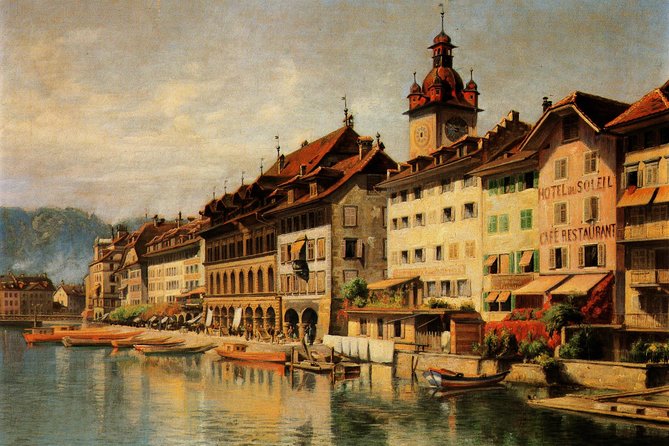
At the riverside square called Im Zöpfli, the subject turns to law and order. Projected paintings show methods of prosecution, interrogation, and corporal punishment in medieval Lucerne.
This is one of the darker sections, and the guide does not soften the subject. You should expect some graphic or uncomfortable material. That said, it explains an important part of how medieval authorities maintained control. Public punishment was meant to be seen, remembered, and feared.
The riverside setting also gives you a brief change of pace. The walk remains outdoors, with the Reuss close by, before crossing Reussbrücke and continuing toward the Spreuerbrücke, the Needle Dam, and sections of the Musegg Wall.
These sights are passed rather than treated as full stops, so you should not book this experience expecting extended visits inside every landmark. The value is the connected route and the stories attached to what you see along the way.
The old pharmacy window
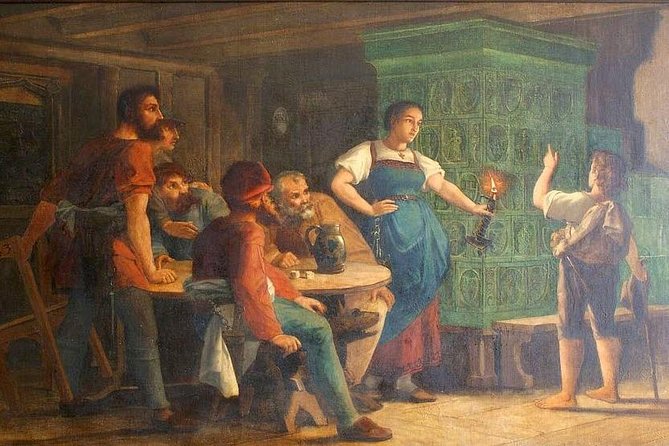
A few steps later, the group reaches the Alte Suidtersche Apotheke. Its medieval pharmacy window is one of the more striking details on the route.
The Nightwatchman explains the house and its location, adding another layer to the town’s history of medicine and commerce. Along with the Latin pharmacy inscription earlier in the walk, this stop shows how much of Lucerne’s story survives in small architectural features.
Admission is not included here. The walk is mainly an exterior experience, so check your expectations if you want to enter historic buildings. You are paying for interpretation of the street and its surviving details, not a series of indoor museum visits.
Ritterscher Palace and the Dance of Death
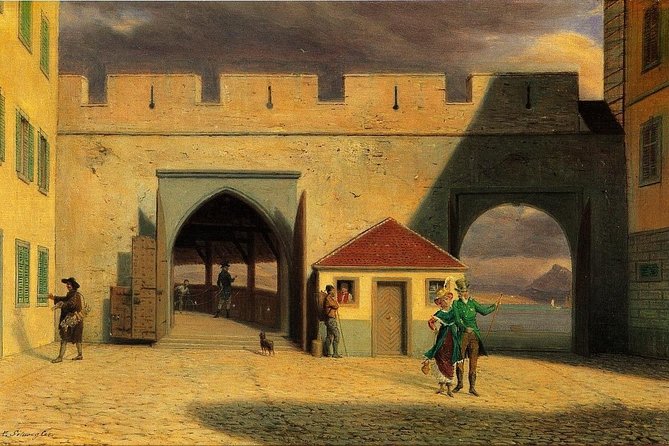
At Ritterscher Palace, the guide introduces guardian demons and the legendary house of Lux Ritter. You hear why the first two floors look different from the third, then learn the story of Hans von Trient, an unlucky stonemason.
The visual centerpiece is a presentation of seven paintings from the Dance of Death. The images are projected onto a house wall while the guide explains their meaning. This is a clever use of the night setting. Rather than simply telling you that medieval art often reminded people of death, the tour places the images onto the very buildings of the old town.
The material can be solemn and occasionally grim, but it is also one of the clearest examples of how the tour combines architecture, art, and storytelling. If you enjoy murals and symbolic decoration, allow yourself time to look closely at the old facades during the walk.
Jesuit Church, Chapel Bridge, and the finish
On the way back, you pass the Church of the Jesuits, described as the first Baroque building in Switzerland, dating to 1677. It is a later building than many of the medieval sites, but its inclusion helps show how Lucerne changed after the Middle Ages.
The tour ends by crossing Chapel Bridge. You see its paintings and learn why the bridge was built diagonally across the river. The walk finishes back at the starting point near Rosengart Platz.
Because the route is a loop, it works well as an evening introduction to Lucerne. You finish close to where you began rather than being left at a distant neighborhood. Still, the experience involves continuous walking through old streets and across bridges, so comfortable footwear matters.
What the $39.54 price gets you
At $39.54 per person, this is not the cheapest way to walk around Lucerne, but the price is reasonable if you want more than a free orientation walk. You are paying for a 90-minute guided route, a period-dressed local guide, visual presentations, postcards, and a carefully shaped set of stories.
The group maximum of 15 is important. A small group makes it easier to see projected images, hear the guide, and ask questions. It also keeps the Nightwatchman character from becoming a distant figure at the front of a crowd.
There are no hotel transfers, and entry tickets at Peterskapelle, the old pharmacy, and Ritterscher Palace are not included. That is not a major concern because the experience focuses on the streets and exteriors, but you should not confuse it with an admission-based museum tour.
The free fountain-water tasting and postcards are modest extras, not reasons by themselves to book. The real value is the combination of route, stories, map, artwork, and evening atmosphere.
Who will enjoy this Lucerne walk
I would recommend this experience to you if you want a strong introduction to Lucerne’s old town and prefer stories to a dry list of dates. It suits families, couples, first-time visitors, and people who have already spent a few days in the city but want to see familiar streets differently.
The family angle is especially good because children up to 12 are free when accompanied by an adult. The fire horn, ghost story, secret rooms, demons, and projected Dance of Death paintings give younger visitors memorable hooks. Parents should decide how their children will handle the material about torture, executions, and corporal punishment.
The tour also works well for repeat visits. The route includes small details that are easy to miss, including the stone house, old measurements, pharmacy inscriptions, guest-house signs, and the differences between floors at Lux Ritter’s house. A first visit may help you get your bearings, while a later visit can fill in the stories behind the facades.
I would be more cautious if you have difficulty walking at a steady pace. One person found the guide a bit fast, and the tour does cover several streets and bridges in a relatively short time. You can ask the guide to slow down, but the group still has a planned route to complete.
Practical details for the evening
The tour is offered in English and accepts mobile tickets. Confirmation arrives at booking, and the activity starts and ends at Rosengart Platz, 6004 Luzern.
It operates in rain, snow, or fair weather. Bring a raincoat or umbrella and dress for the conditions. Evening temperatures can change, and standing outdoors while listening may feel cooler than walking between stops.
Service animals are allowed, the meeting point is near public transportation, and most people can take part. The group is limited to 15 people. Free cancellation is available up to 24 hours before the start time, but cancellations or changes made inside that window are not accepted for a refund.
Should you book the Nightwatchman walk?
Book it if you want Lucerne’s old town explained through stories, symbols, and dark humor, not just photographed from the riverbank. The Martiniplan, projected artwork, medieval costume, and small architectural details give the experience a clear identity.
Skip it if you want long indoor visits, a quiet architectural lecture, or a very slow stroll. The route is outdoors, the pace can be brisk, and some material is gory.
For most visitors with one evening in Lucerne, I think the tour offers solid value. It gives you a useful map of the old town, a memorable look at medieval life, and enough unusual details to keep the city interesting after the walk ends.
FAQ
How long is the Nightwatchman walk?
The walk lasts approximately 1 hour and 30 minutes.
Where does the tour start and finish?
It starts at Rosengart Platz, 6004 Luzern, Switzerland, and ends back at the same meeting point.
What language is the tour offered in?
The tour is offered in English.
How many people can join the tour?
The activity has a maximum group size of 15 people.
Are children allowed on the tour?
Yes. Children up to 12 years old are free, but they must be accompanied by an adult.
Does the tour run in bad weather?
Yes. The tour takes place rain, snow, or shine. You should dress appropriately and bring an umbrella or raincoat.
Are entrance tickets included?
Admission is not included at Peterskapelle, the Alte Suidtersche Apotheke, or Ritterscher Palace. Chapel Bridge and the other listed outdoor stops are free.
Is hotel pickup included?
No. Hotel pickup and drop-off are not included.
Just added around Lucerne
- Luzern Elegance: Private City Walk and Panoramic Lake Cruise★ 5.0 · 3 reviews
- Cheese, Chocolate and Wine in the Bern Region from Luzern★ 5.0 · 3 reviews
- Best of the Uri Alps: A fjord-like lake, glorious peaks and sustainable tourism★ 5.0 · 3 reviews
- Lucerne Lakeside and Villas Private Walking Tour★ 5.0 · 3 reviews
- Lucerne: Legends of Lake Lucerne – Steamboat Experience★ 5.0 · 3 reviews
- Lucerne: Glacier Express’s Swiss Alps & Lucerne Private Tour★ 5.0 · 3 reviews
- From Lucerne: Canyoning Adventure in Interlaken★ 4.5 · 3 reviews
- Lucerne: Private Walking Tour and Chocolate Tasting★ 5.0 · 3 reviews
Lucerne Tours, compared.

From Zurich: Mount Titlis and Lucerne Day Tour
Read our review →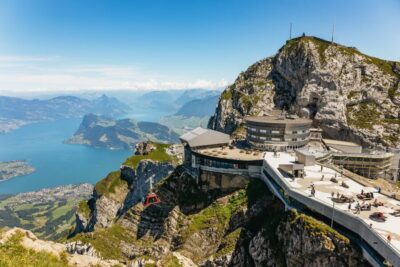
Lucerne: Mt. Pilatus Cable Car, Cogwheel Train & Lake Cruise
Read our review →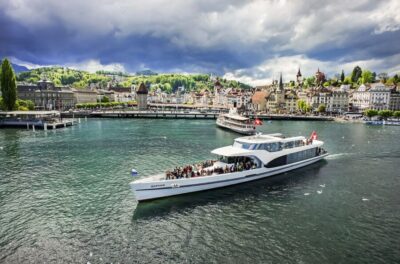
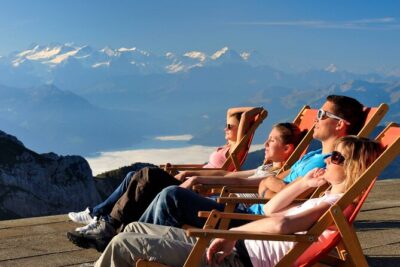
Mount Pilatus Summit from Lucerne With Lake Cruise
Read our review →
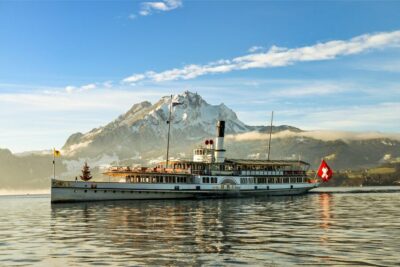
From Lucerne: Mt. Pilatus Gondola, Cable Car, and Boat Trip
Read our review →
From Lucerne: Mount Titlis Half-Day Tour with Ice Flyer
Read our review →
Jungfraujoch Top of Europe Day Trip from Lucerne
Read our review →Browse the lists this tour appears in